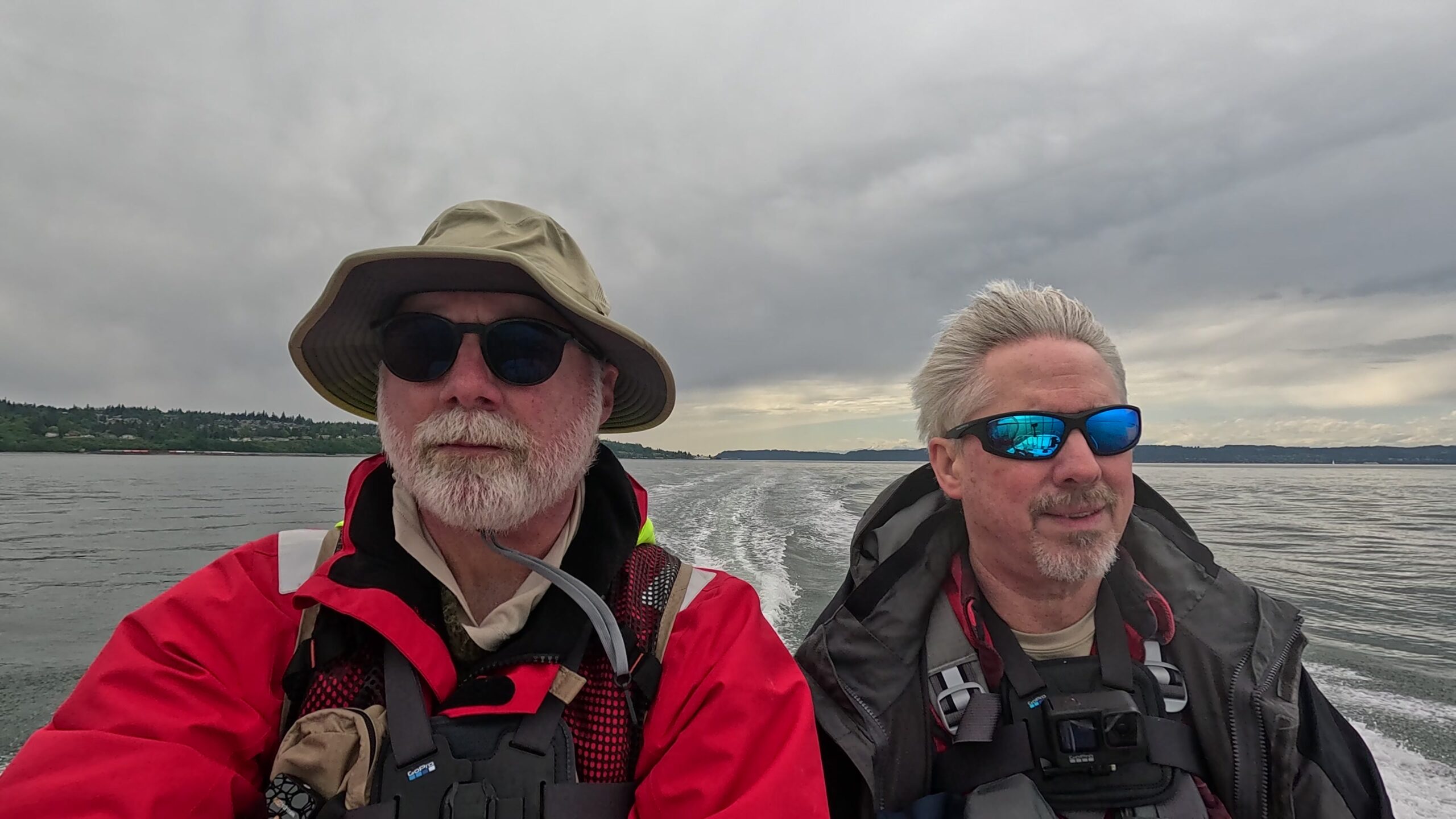
Dave and I were undeterred by our dismal failure at lingcod fishing the previous weekend, so we were right back at it again seven days later. Lingcod are large brown- to blue- colored bottom fish with delicate white meat. They are so delicious that I would probably choose a one over a chinook salmon to eat. We have gained some level of competence at salmon fishing, but lingcod is a whole different ballgame. We still have not been successful in catching one, and I won’t consider myself to be a “real” saltwater fisherman until I do. With salmon we usually troll with downriggers, and we catch them more often than not. Lingcod live on the bottom, especially places with structure like holes, caves, rock piles, or shipwrecks. They hide until some prey swims by, when they aggressively attack. Your lure has to simulate a fish that lingcod like, or better yet, be an actual fish that lingcod like. In Puget Sound most people say that live bait is the best way to catch them, but in the San Juan Islands people catch them more often using artificial lures. Lingcod, like many saltwater bottom fish, prefer to feed during slack tide when less energy is required to move around. So, the fishing window depends on tide more than the time of day. The 10:30 a.m. slack tide that day allowed us a luxurious start time of 7:00 a.m. instead of 4:30, but maybe we should have started a little earlier to allow more time to catch our bait fish.
It was overcast most of the day, but not particularly cold. The Sound was about as smooth as I’d ever seen it in most areas. Dave wanted to try using sand dabs for bait this week, not just shiner perch, and last week we had had some unusual difficulty in catching them. A sand dab is very similar to a small flounder, but with its eyes on the other side of its head. They are abundant and actually taste pretty good, although only the bigger ones have enough meat to be worth the trouble. We decided to make a detour to the Clinton ferry terminal to hunt for them. The spot we chose was just south of there, a large sandy area with a row of white mooring buoys called Columbia Beach. It took a little time to find the right spot, fishing while we watched the ferry come and go. The first one I caught, but it was a large dinner-sized one so I threw it back. It seems that when you are trying to catch big ones to eat, you only get small ones. When you are trying to get small ones for bait, you only get big ones, or none at all. We finally got half a dozen we deemed to be small enough, and we moved on. On our way we stopped at that “Bait Box” place we learned about last week, to grab some shiner perch for good measure. Because there were several other boats there, we decided that I would maneuver the boat to be a few yards away from the pilings where the perch live, while Dave used a sabiki rig to catch the fish. It worked well enough, and in a few minutes we had our fish. We proceeded south the Possession Point for the main attraction. In the process of catching our bait fish, I figured out that I had somehow neglected to pack my leader board, which is the foam board that I tie all my hook rigs up to. It was my first major checklist failure in a long time, and a reminder to not get sloppy. Fortunately, I had two pre-rigged rods with hooks already on them, and Dave had backups of everything. While fishing you always need to be prepared with extras of everything.
When we got to the site of the sunken ferry where we fished last week, there were a crazy number of boats already there. A few minutes later, we watched as one guy spent a long time reeling in a big fish, and then started whooping with excitement as his buddy netted a big lingcod and brought it aboard. This was more action than we had seen there last week, but we didn’t stay there long because the competition was too fierce. We found it a little difficult to maneuver among the other boats. We decided to head west towards Scatchet Head, on the other side of the bar. On the way there we quarreled more than we ever had in our two years of fishing together, as we disagreed on exactly where we should fish. We both felt a palpable sense of frustration about our lack of success, and faced a discouragingly steep learning curve. We quickly put it behind us though, got our teamwork together, and got back to business. The goal is to put your bait fish on the end of a line, with a weight on a slider just above your three-foot leader to hold it underwater. Then you continuously bounce your weight off the bottom, reel up a few feet, and repeat, all while drifting very slowly. It actually requires a lot of boat control; you usually need to keep the engine running with one guy bumping the throttle regularly to keep your lines straight up and down. You need to check your bait fish regularly to make sure it’s still alive and swimming realistically. I fished sand dabs all day, while Dave fished mostly shiner perch.
It’s a natural part of bottom fishing to snag your gear on the bottom and lose it. Dave had snapped his braided line twice last week, while I always managed to free mine. Unlike him, I had come home with all my gear. Today would be different. We both snagged hard on the same underwater ledge, but he was able to free his gear. Mine was snagged so bad that I had to cut my line myself to avoid losing my pole and reel. Although I had no extra leaders in my kit, I just grabbed my spare rod, got a new weight and a new bait fish, and continued on. After doing that for a while we moved to yet another spot on Possession bar, and noted a very pronounced tidal rip. This is where the incoming tide meets the outgoing tide, producing vastly different sea states on either side. We decided to fish along that line, which in salmon fishing is a good idea. However, we found that it contained a huge amount of eelgrass which mucked up our lines, so much that bottom fishing there was quite impossible. Dave had somewhere to be that evening, so we finally gave up about 1:30 and packed up our gear. We gave our remaining a baitfish a stay of execution and dumped them back into the sea.
I always fuel up when returning from a trip, both to reduce any water condensation in my tank, and so that I’m always starting each trip with maximum range. The young lady who worked at the new Port of Everett fuel dock was very helpful. As we approached, she called out that we looked like we were rigged for fishing. I responded that apparently we weren’t rigged for catching. On the short trip from there to the boat launch, the channel was so smooth that you could clearly see the raindrops lightly falling on the water. At the boat launch I was approached as always by the Fish and Wildlife creel counter. It’s essentially a college summer job, and her task is to sit there on a lawn chair at the dock all day with her dog and approach any boats which come in. She asks how many fish we caught, where we caught them, when we caught them, how many we released, etc. If we catch a big fish she measures it. The information is reported on the WDFW website, and is used to by fishery managers to track catch rates. The State of Washington is very serious about managing fisheries, and devotes a huge amount of resources to it. She told me that so far that day she had counted 76 anglers, 31 boats, and only ten lingcod. This kind of a catch rate is far lower than would be typical for salmon.
Although We both felt disappointed at our inability to catch our prize fish, we were starting to gain an appreciation for how relatively difficult they are to catch. That day we didn’t catch an accidental rockfish. At this point, the best strategy is to hire a guide to teach us the finer points. We have both signed up for a training charter in a couple of weeks, but unfortunately it will be near the end of the season. Still, we are dedicated fishermen, dedicated enough to continually hone our skills. I know for sure that if we keep trying, eventually we will learn, and eventually we will both catch a nice lingcod.
Discover more from Salish Sea Safari
Subscribe to get the latest posts sent to your email.

