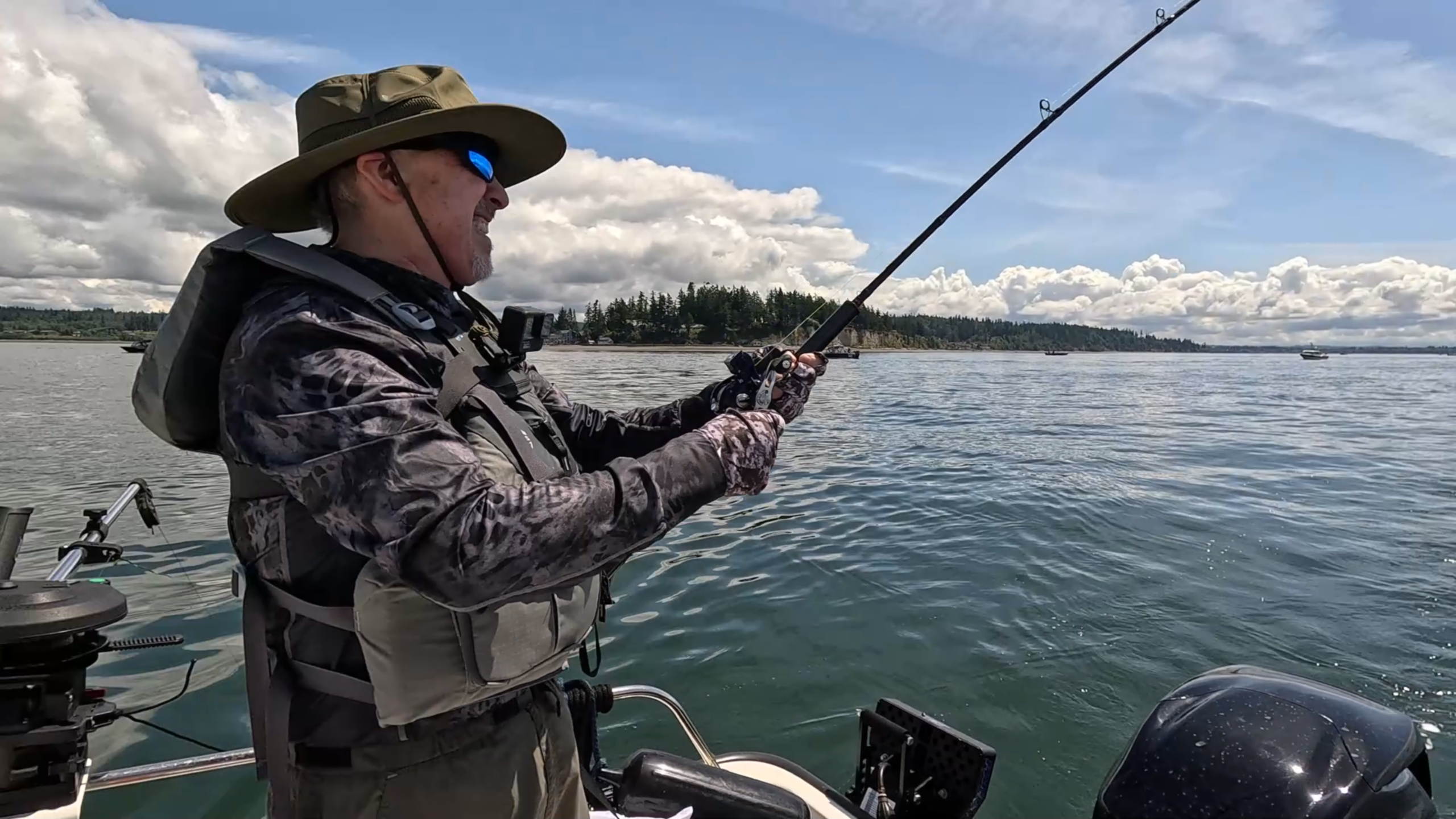
With lingcod and shrimping seasons over, and crabbing season still a week away, there was really only one place to fish: the Tulalip Bubble. Technically called the Tulalip Terminal Area, it’s a thin strip of water that hugs the shore alongside Tulalip tribal land, outside Tulalip Bay. The tribe runs a chinook hatchery there which not only serves their uses, but also provides an active recreational fishery as well. Dave and I fished it last year and didn’t have any luck, but we’ve gained experience since then and wanted to give it another try.
When we got there we found more than 100 other boats already there. Although it can be a bit tricky weaving a trolling path through other boaters going the opposite direction, it was manageable and not particularly stressful. We set up our gear and decided to start at the north end and troll south with the ebb tide. It wasn’t long before my rod started shaking, but not hard enough to come loose from the downrigger. I knew it was something small. My first catch of the day was an inevitable dogfish shark, which are abundant in Puget Sound and often caught while fishing for other things. This one was a real fighter that was hard to get off the line. He was so aggressive that he was trying to hit me with his tail while we worked to get the hook out of his mouth. A short time later my rod did come off the downrigger, but I foolishly decided to let Dave finish something he was working on before stepping away from the helm to grab my rod. By the time I picked it up nearly all the line had been pulled off my reel, about 500 feet. Whatever it was fought hard, and I probably got snagged on something on the bottom. Finally my line snapped. I had lost my favorite red racer flasher, along with the yellow squid lure which I had caught my very first chinook on. I guess you can’t get emotionally attached to your fishing gear.
Fortunately, I keep a backup rod at the ready. I grabbed it, along with a different colored flasher and a similar squid lure, and was fishing again within minutes. A little while later, my rod came off the downrigger again, and this time I grabbed it quickly. This was a big fish that fought me tooth and nail. It kept taking line, then I’d gradually reel it in, then it would take more line again. Finally I got it close to the boat, but not quite close enough for Dave to net it. It swam over to the side of the boat and got wrapped around my downrigger cable, causing the line to snap and fish to get free. They say it’s virtually impossible to keep your eyes open when you sneeze. It’s similarly impossible to lose a big, hard-fought fish without dropping a few f-bombs. We had seen the fish and what a monster it was, the kind that doesn’t come along every day, at least not for me. After catching my breath and recovering my senses, I took stock of my situation. The incident happened partly because I had reeled it in too far, and partly because I had moved too far forward in the boat. Experience is something you get right after you needed it. I had lost my backup squid lure, but fortunately not the flasher. Although I had a spoon lure and a couple of anchovy helmets, I opted to stay with the squid since it was attracting fish. Dave loaned me one of his, and after a few minutes I was back for another round.
After another dogfish incident, my rod popped off the downrigger for the third time. It fought almost as hard as the last one, making me grip the rod so heavily that I was breathing hard, and making my left wrist sore as I slowly reeled it in. This time I remembered the lessons of the last lost fish. I left maybe eight feet of line out, held the rod as high as I could to draw the fish to the boat, and I didn’t go forward of the helm. I managed to direct the fish to Dave, and he netted it on the second try. I had redeemed myself, and was rewarded with a nice chinook, the first one of the year.
By this time Dave still didn’t have a single bite, not even a dogfish. We analyzed what I was doing differently. I had been trolling my line as close to the bottom as possible, and he was staying 10-20 feet above me to make sure we didn’t get tangled. We decided to switch, with his lure being on the bottom and mine slightly above his. He started getting bites. At first it was two dogfish and a sand dab. When I was taking my turn at the helm, I saw a huge cloud of small fish on the fish finder that we refer to as a “bait ball”, because salmon tend to hang out there to feed. After the first pass through it, I decided to turn around to hit it again. You can’t turn very tightly when you’re dragging two downrigger balls 100 feet down, lest everything get tangled. I also had other boats to dodge. I managed to maneuver us into a circle around the bait ball though, and it paid off. After a few minutes, a fish grabbed Dave’s line off the downrigger. At first he wasn’t sure it was a fish, but then the fish started peeling line off his rod. He took more than 400 feet of line out before Dave started to wrangle him back. His fish fought even harder than mine, and Dave quickly got battle weary as I had. Finally he brought it alongside, and I netted it on the first try. The victory was sweet… We didn’t have to share our fish; we had each caught one of our own.
Dave is normally super persistent and wants to fish all day until we either catch our limit, or it gets dark. This time though, he suggested first that we quit while we’re ahead and go home. That fish had obviously taken a lot out of him. We were both quite happy with our catch, and could now relax and enjoy the beautiful day. We decided to stop in Langley to eat our lunch at the little park by the marina before heading back to Everett.
Discover more from Salish Sea Safari
Subscribe to get the latest posts sent to your email.

