I’ve always wanted to try shrimping, but I hadn’t planned on going this year for a couple of reasons. First of all, the season is miniscule, and the necessary gear is fairly expensive. In the south Sound they get one day per year, and only four hours at that. In the north Sound area where I live we usually get two days per year, again limited to four hours. However, I recently learned that up in the San Juan Islands, they get six days per year, and they can fish all day. I had always assumed that it was like crabbing in that you needed two pots per person to be successful. However, I learned at a seminar that just one well-baited, well-placed pot can catch a limit of 80 shrimp each for two people. I already had one pot, which I had bought off a guy who moved to Florida a couple years ago, and some of the other gear. So, I decided to give it a go with just one pot.
When most people talk about “shrimping”, they usually mean that they are fishing for spot prawns, which are quite a bit larger than most species of actual shrimp. Shrimping has some similarities to crabbing, which are that you drop a trap which fisherman usually refer to as a “pot”, and mark it with a buoy which floats on the surface. That’s about where the similarities end. The pots are about the same size but are totally different. First of all, the mesh in a shrimp pot is a lot smaller. Crab pots use swinging doors to lock the crabs inside, while shrimp pots just have small openings. The shrimp are trapped in the pot simply by the force of the pot being hoisted to the surface. Most people use 100-foot lines on their crab pots, and fish about 40-60 feet down. You usually use 400 feet of line for a shrimp pot, and fish anywhere from 250 to 325 feet deep. Crabbing gear is required to be red and white for recreational fishermen, while shrimping gear is required to be yellow. Whereas you bait a crab pot with chicken, fish heads, or some other kind of meat, shrimp pots are baited with a strange peanut butter-like mixture that you have to mix. It’s made of a commercial prawn bait which is like hard, smelly dog food, mixed with canned mackerel and a few cans of seafood-based cat food, all blended in a special oil. Because the lines are so much longer, line management is essential to keep from turning your boat into a tangled mess of spaghetti. It’s nearly impossible to coil shrimp lines fast enough by hand, so nearly everyone uses some kind of rope winder opposite the electric pot puller.
My coworker Todd and I met up at 7:00 a.m. on a recent Saturday to give it a try, and I was very optimistic that we’d be successful. I was extremely busy with preparations for a few days before. I had to buy a rope winder and reel, the bait ingredients, the necessary buoys, various hardware devices to attach the rope to both the winder and the pot, etc. Then I had to figure out how to rig all that stuff. I had studied the tides, and found that the currents in our shrimping area would be calm for most of the day, which is essential to keep from losing your pot. In addition, I prepared gear for lingcod fishing. We drove an hour up to the beautiful Cornet Bay boat launch on the north end of Whidbey Island, just inside Deception Pass. We found it to be a complete zoo. The parking lot was already full at 8:00 a.m. and there was a line to launch your boat. We went to a restaurant up the road to prepare all our gear, got in line, and launched. I finally found a spot for my car and trailer along the road some distance away, and then had to hike back to the boat while Todd and everybody else waited.
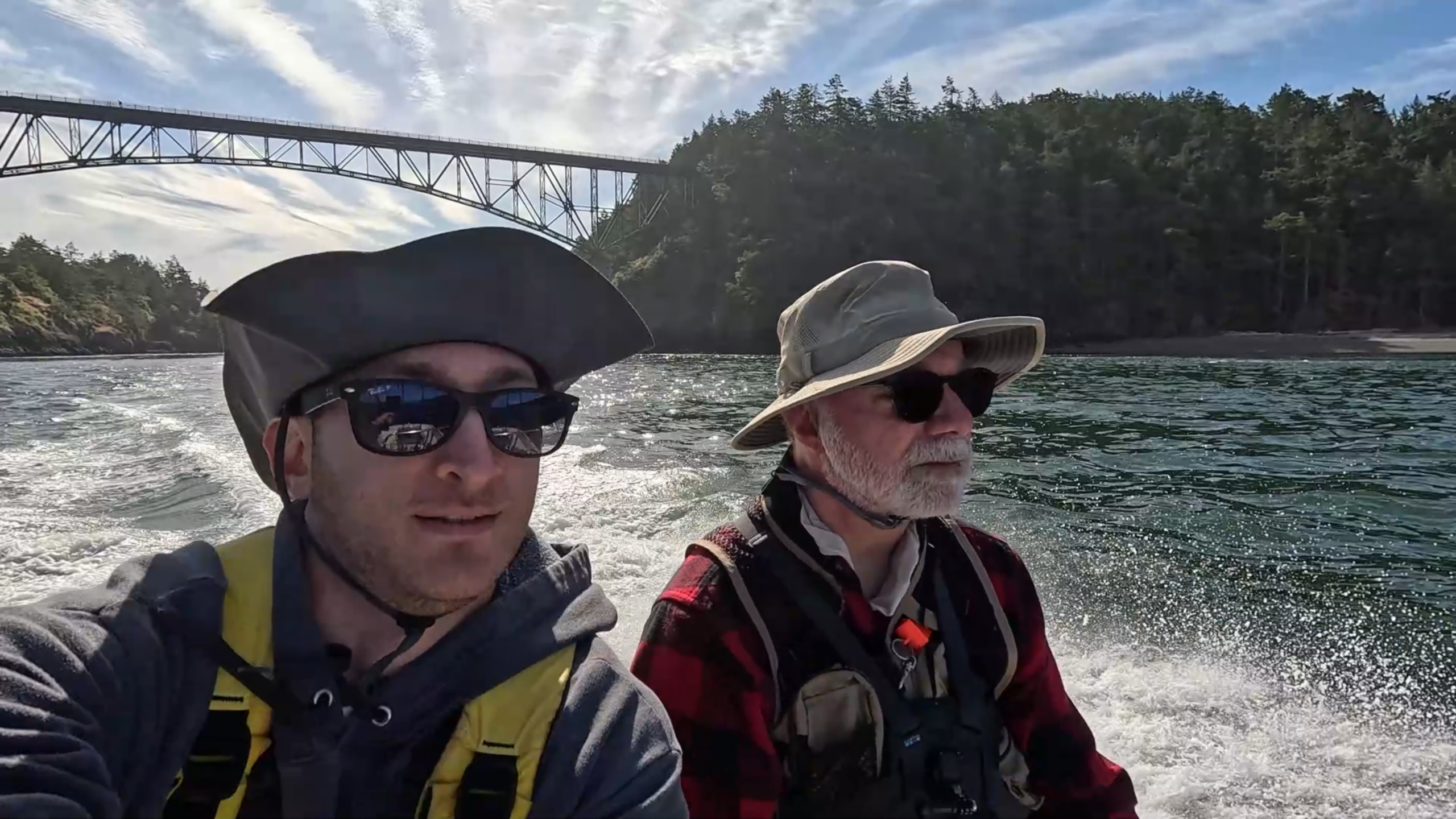
As frustrating as that was for everybody, we all kept our cool and got the job done. We got in the water not long after 9:00, which was still well ahead of slack tide. We went through the somewhat turbulent Deception Pass, the site of Washington’s most popular state park, and passed under the famous green bridge with 3 knots of current against us. The most popular fishing grounds were off the south end of Lopez Island, but to get there I’d have to cross Rosario Strait, which is a pretty large body of water for my little 15-foot boat. Although the weather was nice that day, I knew that unforecast winds often pick up in the afternoon, with unpredictable results. Just to be safe, I had planned to drop near a reef just two miles outside of Deception Pass, where I could more easily duck if the seas got rough. When we got there we found that the current was well above the 1 mph target speed for a safe pot drop. We fished for lingcod for a while, and predictably we didn’t catch anything. So, we headed for a place called Biz Point, which is to the north of the pass, where we expected the currents to be slower. We found that just as predicted, they were under 1 mph, so we prepared everything for our first drop to 250 feet. The conditions were ideal.
We baited the pot, connected it to the line, and dropped it overboard. We slowly let it down, but then we ran into a serious problem: we ran out of rope before we hit the bottom. We stood there perplexed for a moment until I realized that the old rope I had bought off that guy was probably only 200 feet, not 400! We moved closer to shore where the water was a little shallower, but again we never hit bottom. Our hopes of a successful shrimping day were dashed by a stupid mistake on my part. We decided to head up to Burrows Island, where we had done a little lingcod fishing on the charter the week before, to try our luck at that. Getting your gear stuck on the bottom and losing it is a necessary part of bottom fishing. Still, it only took Todd ten minutes to lose the $10 lure I had just bought the day before. Knowing that the current was less than ideal for that kind of fishing to begin with, I decided that we’d just take a scenic cruise through the nearby islands and head back. It was a nice calm day, and the islands were gorgeous, so at least we had that.
After driving around and shooting some nice video, we came back through Deception Pass. I had expected to come there later in the day at slack tide, but at the time we actually came through we had five knots of current behind us. Going with the current through a narrow pass is actually more dangerous than going against it, because you have less speed control. Outside the pass we immediately got slammed by the wakes of several boats which were hauling ass out to sea. We noticed one boat which was hauling ass into the pass, which gave us confidence, so we went for it. The water was far more turbulent than on the way in, and it was going in all kinds of unpredictable directions, shaking the boat even side to side. We felt like we were in a washing machine. My Whaler has plenty of power to ride it through though, and we got through it just fine.
We stopped for a snack at a safe distance away from the pass, and then headed back to the boat launch. The hardest part was the embarrassing text to my wife telling her that she’d have no shrimp for dinner. Fortunately, we are scheduled for another shrimping day in two weeks, and she has committed to coming with me herself. I’ll consider Saturday’s trip to be a “dress rehearsal” to work out all the kinks, and get ready for the big event next time.
Discover more from Salish Sea Safari
Subscribe to get the latest posts sent to your email.

