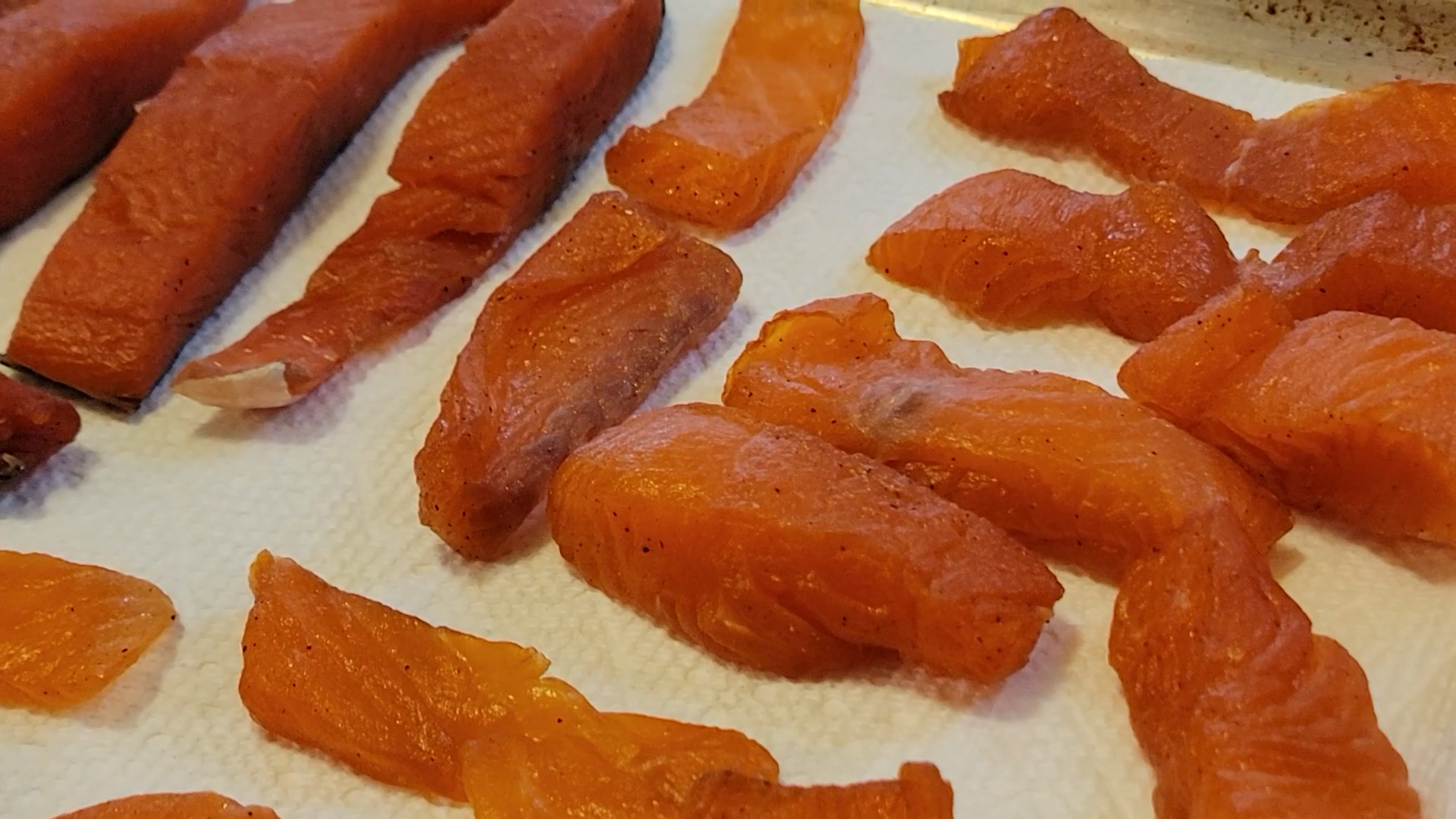
There are six main types of North American salmon. Which ones taste the best? The answer may surprise you. My fishing buddy Dave and I put all six of them side by side in a salmon tasting event. In this post I’ll tell you our takeaways, along with four tips for hosting your own salmon tasting party.
These are the details about the six types of salmon we compared:
| Chinook/King: Typical Size: 10-30 pounds Lifespan: 3-5 years, returning in early summer Fat Content: ~13% Origin: Wild caught by Patrick Hall off Tulalip |
| Chum/Keta: Typical Size: 8-15 pounds Lifespan: 3-6 years, returning in winter Fat Content: ~5% Origin: Wild caught in Alaska via Sea to Shore Seafoods at Everett Farmers Market |
| Coho/Silver: Typical Size: 6-12 pounds Lifespan: 3-4 years, returning in late summer/ early autumn Fat Content: ~5% Origin: Wild caught by Patrick Hall near Deception Pass |
| Sockeye/Red: Typical Size: 5-8 pounds Lifespan: 4-5 years (2-3 years in a freshwater lake, plus 2-3 years in the ocean), returning mid-summer Fat Content: ~6% Origin: Wild caught by Patrick Hall and David Smith in Baker Lake |
| Pink/Humpy: Typical Size: 3-5 pounds Lifespan: 2 years, returning in late summer Fat Content: ~5% Origin: Wild caught by Patrick Hall and David Smith near the Edmonds shipwreck |
| Farmed Atlantic: Typical Size: 8-12 pounds Lifespan: 2-3 years before harvesting from a net pen Fat Content: ~11% for farmed fish, 5-8% for wild Origin: Farmed (exact source TBD). Note: Wild Atlantic salmon is not available for sale in the US. |
Here are our takeaways from our salmon tasting event:
First of all, preparation is everything with salmon. You can have the best fish in the world, and if it’s not prepared properly, it’s not going to taste its best. And it’s actually going to skew the results in a competition like this.
We also learned that smoking tends to make all the different types of salmon taste more alike. Some of our guests actually had difficulty telling them apart. In my opinion, smoking elevates some of the cheaper, less popular fish like sockeye and pink. But smoking might actually take something away from a really nice Chinook. And a nice fish like that should probably be grilled instead.
There’s no accounting for taste. People were all over the map as far as what they liked and what they didn’t like. And what one person liked, the person next to them didn’t like. Everybody was surprised, especially themselves.
Farmed Atlantic salmon was very popular. It came in second for the grilled and also ranked very high for the smoked. A lot of people have a preconceived notion that farmed is bad. And although there are some environmental considerations to think about when buying farmed salmon, as far as the taste goes, it was very popular.
Here are the election results from the event:


Here are some tips you can use to hold your own salmon tasting event:
First of all, I would recommend starting out with a target of 12 ounces per person and divide that up by the number of samples. So in our case, we had six smoked samples and six grilled samples, so we provided one ounce samples of every type of fish.
I also recommend that you put all the samples together on one plate. We didn’t do this at first because we’d never done this before and we were making it up as we went along. Initially, we put them all in different plates and kind of tried to serve them one by one. But people really needed to be able to go back and forth to question whether the one they just ate was really better or worse than the one they had before, and it was just a lot more helpful to put them together on one plate.
I would recommend that you use numbers to identify them instead of the actual name of the fish. First of all, you don’t want people to be biased by their preconceived notions, and using numbers tends to eliminate that problem. Second, people love a mystery, they love a surprise, and we found that several of our guests got really into the suspense of not knowing which kind of fish was which, and they were just dying to know the answer by the end.
Finally, I recommend that you provide bread for people to use to cleanse their palate in between samples. We found that several of our guests made good use of that.
Conclusion: This event was a lot of work to put on. It’s not something you’d want to do every day. It was a lot of work to smoke the fish, to grill the fish, and to even procure the fish, or, in our case, to catch the fish. And it was a lot of trouble to make sure we kept them separate during the preparation process. However, it was a very unique and fun event. None of us had ever heard of anybody doing a salmon tasting event before, and I think that the people who participated felt like they were honored to be invited. It was just a lot of fun.
Discover more from Salish Sea Safari
Subscribe to get the latest posts sent to your email.


this is great. I’ve never seen a similar comparison. Great work. I wish I could have tasted them all. Ha.
Yeah, it’s really kind of surprising that there aren’t more comparisons of this sort out there.