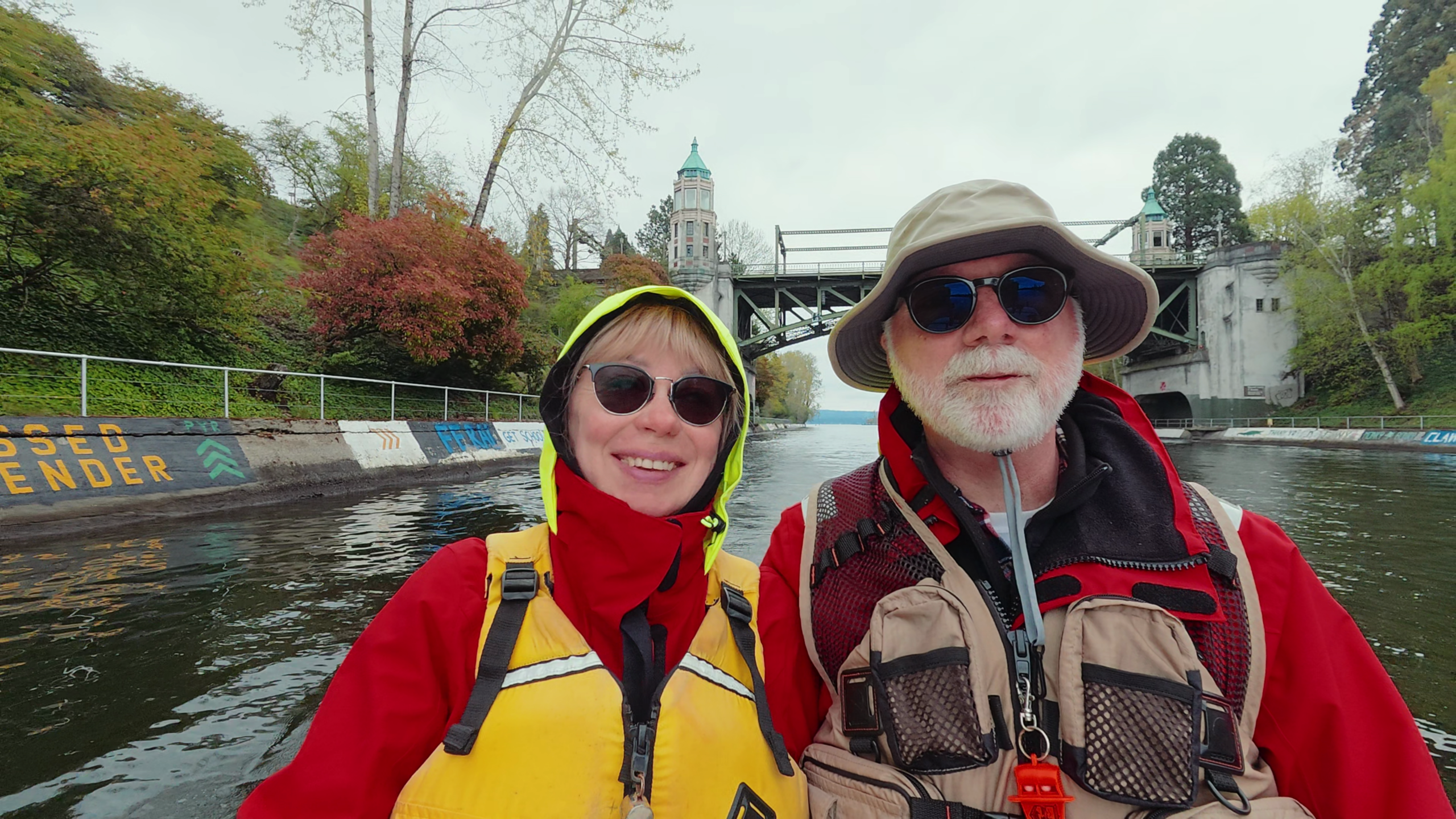
My wife and I like to do a fun little shakedown cruise at the beginning of each boating season. It helps me to understand any issues I need to fix before fishing season, and it helps Viktoria to practice handling the ropes. Never mind that I’ve already been out twice already this year. Plus, it’s kind of a date. This time we chose the Seattle ship canal for a leisurely low-speed cruise to Chinook’s restaurant at Fisherman’s Terminal. It was overcast and colder than we hoped it would be; the last vestiges of winter haven’t shaken off yet. We drove to Magnuson Park via some shockingly steep hills. I was glad I had an ox of a tow vehicle, which is rated for twice the weight of my boat and trailer. There were not as many people or boat traffic as we expected at the park, so there was no competition for parking or dock space. There were thankfully few joggers with dogs in our way as we backed down the ramp. Magnuson has a frustratingly shallow boat launch, which requires you to practically submerge your tow vehicle to get deep enough to float the boat. Fortunately my Cherokee can ford 20 inches of water. Aside from that, launching was a snap.

It’s rare for my outboard to drink fresh water, and my increasingly rusty trailer probably appreciated a clean water bath as well. On the water I noticed that the boat accelerated faster than usual, because of how smooth Lake Washington is compared to Puget Sound. When I pushed it to 4000 rpm to get it on plane, it accelerated easily through 25 mph before I throttled back. On the Sound I usually cruise at more like 21 for a similar amount of power. I enjoyed the smooth, quick ride, while my wife shivered by my side. It didn’t last long. In just a few minutes we rounded the green buoy that marked the entrance to the channel. From there to the Ballard Locks we’d be limited to 7mph and no visible wake.
Viktoria studied the houseboats on Portage Bay, while I studied everything else that floated. Seattle has a whole maritime world of its own that landlubbers never notice. There are countless marinas, piers, ship repair facilities, gas stations, boat sales yards, on-water restaurants, and more. Connected to these are hundreds of fishing trawlers, ocean going tugs, fish processing ships, work boats of every variety, including a large UW research vessel, and untold thousands of recreational boats. If you live or work in the freshwater part of Seattle, you get to know this half-seen world and all its nooks and crannies.

One of the most scenic parts is the Montlake Cut, which forms the southern boundary of the University of Washington campus. Husky pride is on display everywhere in murals along the water’s edge. The Montlake bridge, built in 1925, is probably the most beautiful of the four drawbridges along the route, though the University and Ballard bridges are both pleasing to look at as well. Just west of the cut is the entrance to Lake Union. The most direct route hugs the shore of Gasworks Park. The park had just opened in 1976 when nine-year old me was living just a few blocks away in Wallingford for a short time. It was bright, shiny, and new back then, and I thought it was the coolest place to explore with my bike. Now it is under threat of being removed by the City Council. The best views of downtown Seattle are from Lake Union. The Fremont Bridge, the next in line, was orange when I was a kid. I used to walk to B.F. Day school for my fourth grade classes, and it wasn’t far from the bridge. Now it’s blue with orange trim, notably different in appearance from the other drawbridges, and of questionable taste. It is the most-opened bascule drawbridge in the US, as it is lower to the water than the others which cross the canal. They opened it for a sailboat just as we approached, and I joked about how they were opening it just for us.

West of the canal is fairly featureless until you get near Fisherman’s Terminal, where the vessels and vibe noticeably change from more recreational to mostly industrial. The west end, near the Ballard Locks, is definitely the working part of the canal. My dad used to work down there doing marine electronics back in the 70s. As hard as it is to park a car in Seattle, it isn’t hard at all to park a small boat in front of Chinook’s. There’s a free dock there for as long as you’re eating in the restaurant. Chinook’s is now owned by Anthony’s (like just about every other seafood restaurant in western Washington). We had some nice rockfish tacos, and Viktoria enjoyed some white wine before the return trip.

To get back home we had to navigate a vast maze of big fishing boats, which surrounded the way to the restaurant dock. In the channel we passed a beautiful antique yacht going the other direction. As we rounded gasworks park again, I stopped the boat to chat with some ladies having a good time in a floating hot tub boat. They didn’t notice that they had floated right into the path of transiting boats, but everyone was slow enough that it wasn’t a big deal. Lake Union is usually full of seaplanes, but we only saw two that day.

The trip was about three hours, not including time at the restaurant. It was a fun date. Seattle has been through a lot in the past ten years, but from the water it’s still a beautiful city with a unique maritime vibe.
Discover more from Salish Sea Safari
Subscribe to get the latest posts sent to your email.


Enjoyed the story. Thank you for sharing. Living in Tampa, FL, we have nothing like that.