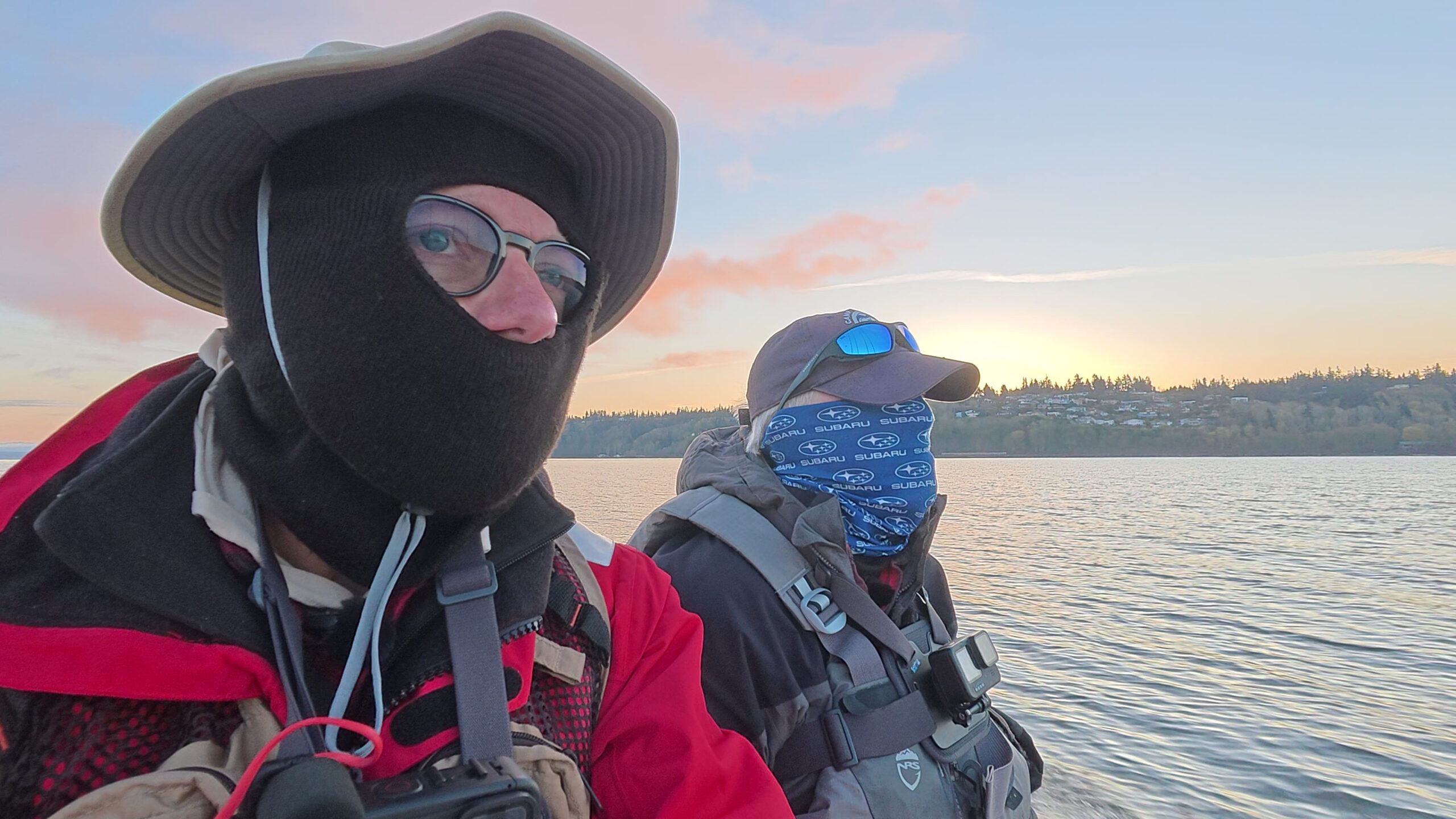
My first fishing day of 2026 was supposed to begin at 4:00 am. Because I woke up in the middle of the night and couldn’t get back to sleep, though, it actually started around 2:45. I would have to survive on just four hours of sleep. I got the boat ready and met up with Dave at 5:30. Blackmouth opened on April 1st, and is supposed to be open through April or until the quota is met. Because of that quota, though, everyone is expecting them to close the fishery on Monday or shortly thereafter. “Blackmouth” is a fisherman’s term for resident hatchery chinook salmon, which were traditionally open for catching all winter long but are now only open for about a week in April.

Dave and I had initially planned to take opening day off work to fish, but we postponed because of bad weather. The first three days have all been a bit rough, even when forecast to be calm. Fortunately we launched into smooth seas, which we enjoyed all day. It was so dark that I couldn’t tell how deep the trailer was in the water when backing down the ramp, and had to rely on Dave to tell me. It was only 42 degrees, which is hard to endure for an hour-long cruise to our fishing grounds in a little open boat. We had come prepared with gloves, extra sweaters, and balaclavas to cover our faces. It was all worth it for the beautiful sunrise though. Recent rains had left lots of floating debris in the water, and incredibly clear skies after the morning haze burned off. This gave us incredible views of Mount Baker and the Olympics.

The nearest place that was open to Blackmouth was just south of the Edmonds marina, a place we call the Oil Docks (Point Wells). Last year we did well there and come home with one nice fish. When we finally got there, we set up all our gear and were fishing by 7:30. According to my logs, we were a half hour ahead of last year’s trip to the same place. It didn’t take long to get the first fish on, but it was too small. For the next three hours we caught fish after fish, nearly a dozen in total. However, every one was either unclipped or less than the 22″ minimum size. We really worked it, trying a variety of depths and a variety of gear. We tried hardware lures called “spoons”, hoochies with brined herring, and anchovy helmets. Dave did better with the spoons and I did better with the hoochies. I never caught anything on the anchovy helmets, though the technique is intriguing if I ever get it down. The bite dried up completely around 10:30, and we never got another nibble despite all our efforts. Around 12:30 we gave up and headed home.

During the day we saw all kind of interesting vessel traffic: distant container ships, a pair of ocean-going tugs, a few big ships we couldn’t identify, and of course ferries. We had to cross both the Mukilteo-Clinton and Edmonds-Kingston routes. We’ve learned that those things are much faster than they look, and it’s usually foolhardy to try to cross in front of one. If you have to cross behind it instead, you might have a big wake to deal with. On the way back north we would need to cross in front of the Mukilteo ferry dock, and a boat was approaching. We debated whether we could make it in front or not, and finally decided that we could if we gave it more power. I took it from a 20 mph cruise to a 25 mph sprint (it can do 30 in smooth seas). Partly because the ferry slowed as it approached the dock, we made it with plenty of room to spare (and without getting honked at).

One thing I love most about fishing is the opportunity to learn about nature. The sea exposes the weather much more clearly than the land does; we noticed lots of microclimates on the way home. One area had smooth, shiny seas, and then we’d cross a very visible line into more blustery conditions, with a noticeable temperature drop and choppier seas. I’m sure that similar things happen on land, but you can’t read them as clearly as you can on the water.

On a typical day of fishing I burn about 5 gallons of gas, which is excellent for a boat. Many guys with big twin outboards spend over $100 for a day of fishing, and that was before the recent surge in gas prices. For the long trip to Edmonds and a morning of trolling, we burned over 7 gallons of gas. The port of Everett is now charging $6.01 for their ethanol-free gasoline, so the bill came out to $43, which Dave kindly paid. I’m sure that’s the most we’ve ever paid, and at times like this I’m kind of glad I never upgraded my boat.

The tide was so low when we returned to Everett that the ramp was muddy. I always wear rubber boots when I launch and recover the boat, and this time my boots were sticking in the mud so much I thought my feet were going to pop out. When I got home I was completely exhausted and had a slight sunburn. In the dark, cold, morning it never occured to me to put on sunscreen. I went to bed at 8:00 p.m., slept nearly 11 hours, and woke up still feeling tired on Sunday. It’s amazing how much energy the cold wind, the bare sun, and the constant rocking of the boat can take out of you. Because my boat is tiny, it has no toilet and we have to deprive ourselves of food and water to survive a whole day aboard. When you add sleep deprivation and chilly temperatures to that, fishing is physically taxing. This makes it even more disappointing when you come home with no fish. Still, it was worth it for the experience. In my book, it was a day well spent.

Although I shot plenty of footage on this trip, I’m not sure I’ll make a video or not because it’s so similar to last year’s Blackmouth fishing trip. Please enjoy these screenshots for now.
Discover more from Salish Sea Safari
Subscribe to get the latest posts sent to your email.

